Concrete
Concrete Bags Calculator: How Many Bags Do You Need?
Understand concrete bag yields, convert volume into bags, and compare 40, 60 and 80 lb bags (and 20–30 kg bags) with worked examples and a quick reference table.
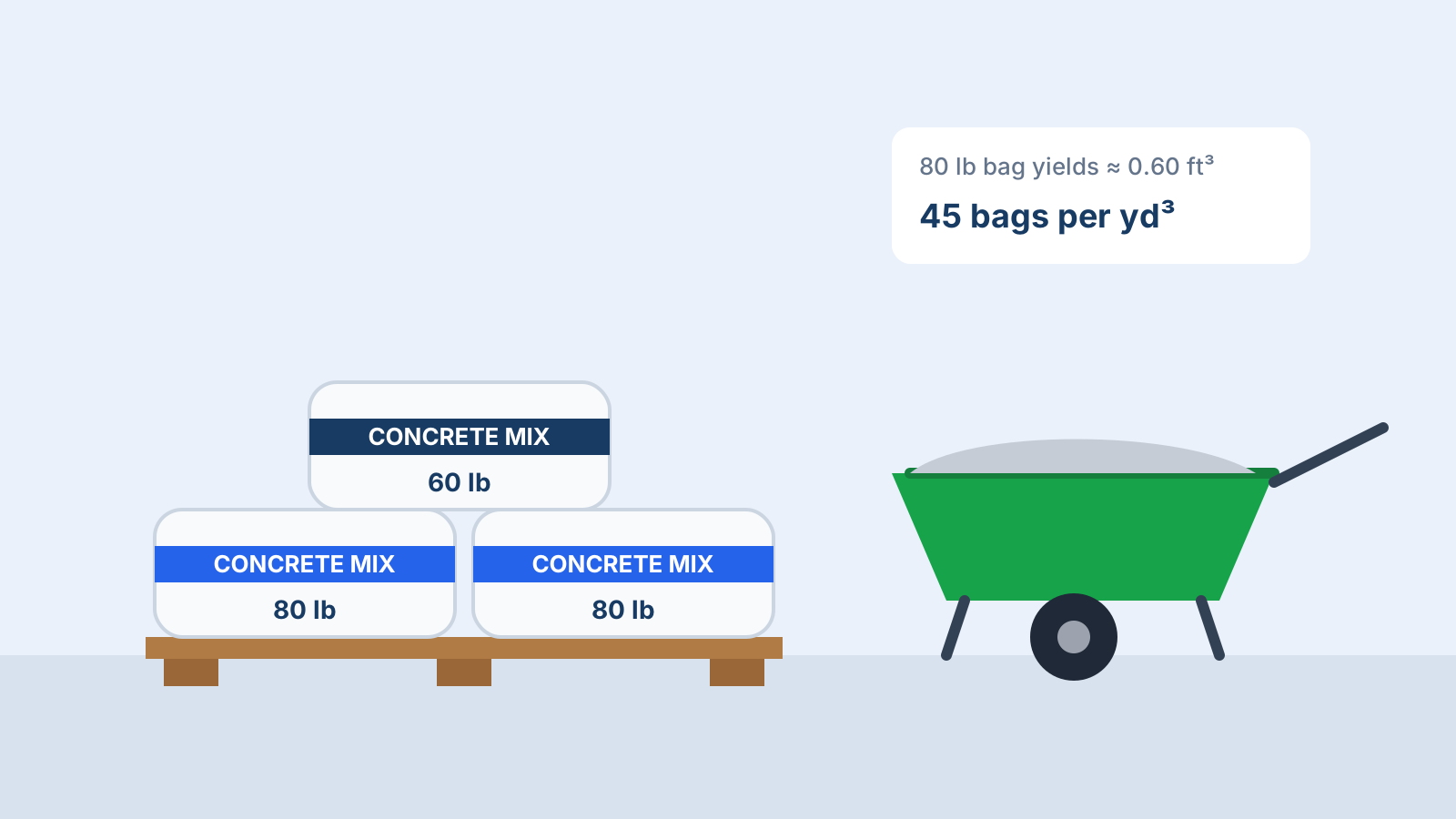
A bag of concrete is labelled by weight, but you pour it by volume. That mismatch is why so many DIY projects end with a last-minute trip to the store.
This guide explains bag yield, gives you a quick reference table and shows how to convert any volume into the number of bags to buy.
What is bag yield?
Yield is the volume of finished concrete one bag produces after you add the right amount of water. It is printed on the bag, usually in cubic feet or litres.
| Bag size | Typical yield | Bags per cubic yard | Bags per cubic metre |
|---|---|---|---|
| 40 lb | 0.30 ft³ | 90 | ≈ 118 |
| 60 lb | 0.45 ft³ | 60 | ≈ 79 |
| 80 lb | 0.60 ft³ | 45 | ≈ 59 |
| 20 kg | ≈ 9.4 L | ≈ 82 | ≈ 107 |
| 25 kg | ≈ 11.7 L | ≈ 66 | ≈ 86 |
| 30 kg | ≈ 14 L | ≈ 55 | ≈ 72 |
These are typical values. High-strength, fast-setting and fibre-reinforced mixes can yield differently, so always check your product.
Converting volume into bags
- Calculate the volume of your project in cubic feet (or litres).
- Add a waste allowance, usually 5–10%.
- Divide by the yield of one bag.
- Round up to the next whole bag.
Example
A 4 × 4 ft pad, 4 in thick
- Volume: 4 × 4 × (4 ÷ 12) = 5.33 ft³
- With 10% waste: 5.87 ft³
- 80 lb bags: 5.87 ÷ 0.60 = 9.8 → 10 bags
- 60 lb bags: 5.87 ÷ 0.45 = 13.04 → 14 bags
Result: Buy 10 × 80 lb bags or 14 × 60 lb bags.
Which bag size should you choose?
Larger bags are normally cheaper per cubic foot, but an 80 lb bag is heavy to lift, carry and mix by hand. Consider:
- 80 lb / 30 kg: best value for slabs and pads when you have a mixer or help.
- 60 lb / 25 kg: a good compromise for fence posts and working alone.
- 40 lb / 20 kg: easier to handle for small repairs or awkward access.
Don't forget transport. Forty 80 lb bags weigh 3,200 lb, more than many pickup trucks and trailers can safely carry in one trip.
When to switch to ready-mix
Once you need more than about 40–50 bags (roughly a cubic yard), mixing by hand becomes a long, tiring job and it gets harder to keep a continuous pour. At that point, compare the cost of ready-mix delivery, including any short-load fee.
Try the Concrete Bag Calculator
How many 40, 60, 80 lb or 20–30 kg pre-mixed bags you need.
Frequently asked questions
How many 80 lb bags of concrete make a yard?
About 45 bags, based on a typical yield of 0.60 ft³ per bag (27 ÷ 0.60).
How many 60 lb bags of concrete make a yard?
About 60 bags at 0.45 ft³ per bag.
Can I mix two bag sizes in one pour?
Yes, if they are the same product type. Just add up the yields of each bag to make sure you have enough volume.
About the author
Written by the BuildCalcWorld Editorial Team. Our guides explain standard estimating methods with worked examples you can verify. Material properties vary by product and region, so always confirm specifications with your supplier. Published . Learn more about us.
Related articles
 Concrete
How Much Concrete Do I Need for a Concrete Slab?
Learn how to calculate concrete for a slab step by step, convert to cubic yards or cubic metres, add the right waste allowance and decide between bags and ready-mix.
3 min read Concrete
How to Calculate Concrete for Fence Posts
Calculate how much concrete you need per fence post, including hole size, post displacement and gravel base, with examples for 4×4 and 6×6 posts.
3 min read