Concrete
How Much Concrete Do I Need for a Concrete Slab?
Learn how to calculate concrete for a slab step by step, convert to cubic yards or cubic metres, add the right waste allowance and decide between bags and ready-mix.
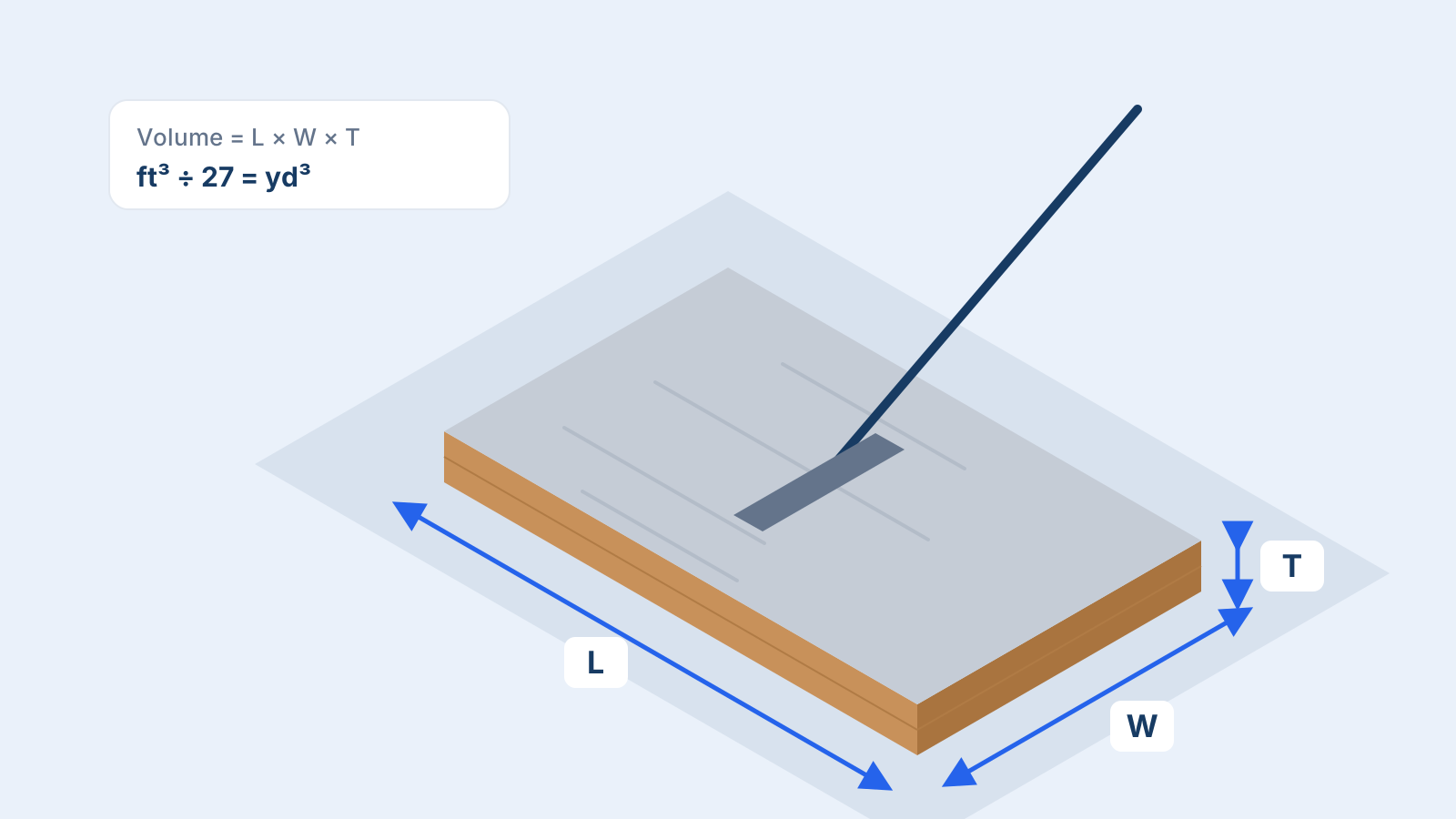
Ordering concrete is one of those jobs where a small mistake gets expensive quickly. Order too little and you end up with a cold joint where fresh concrete meets concrete that has already started to set. Order too much and you pay for material you have to dispose of.
The good news is that the maths is simple once you keep your units consistent. This guide walks through the calculation for a rectangular slab, explains how much extra to allow, and shows when bags make sense and when you should call a ready-mix supplier.
The basic slab formula
A slab is a rectangular box, so its volume is simply length × width × thickness. The only trap is units: slab length and width are usually measured in feet or metres, while thickness is measured in inches or centimetres.
- Imperial: convert thickness to feet (inches ÷ 12), multiply to get cubic feet, then divide by 27 to get cubic yards.
- Metric: convert thickness to metres (centimetres ÷ 100) and the result is already in cubic metres.
Ready-mix concrete is sold by the cubic yard in the US and by the cubic metre in most other countries. There are 27 cubic feet in one cubic yard.
Worked example: a backyard patio
Let's say you are pouring a 16 ft × 12 ft patio, 4 inches thick.
Example
16 × 12 ft patio at 4 in thick
- Thickness: 4 in ÷ 12 = 0.333 ft
- Volume: 16 × 12 × 0.333 = 64 ft³
- Cubic yards: 64 ÷ 27 = 2.37 yd³
- Add 10% waste: 2.37 × 1.10 = 2.61 yd³
Result: Order about 2.75 yd³ of ready-mix (many suppliers sell in quarter-yard increments).
The same patio in metric would be roughly 4.9 m × 3.7 m × 0.10 m = 1.81 m³, or about 2.0 m³ with 10% extra.
How much extra concrete should you order?
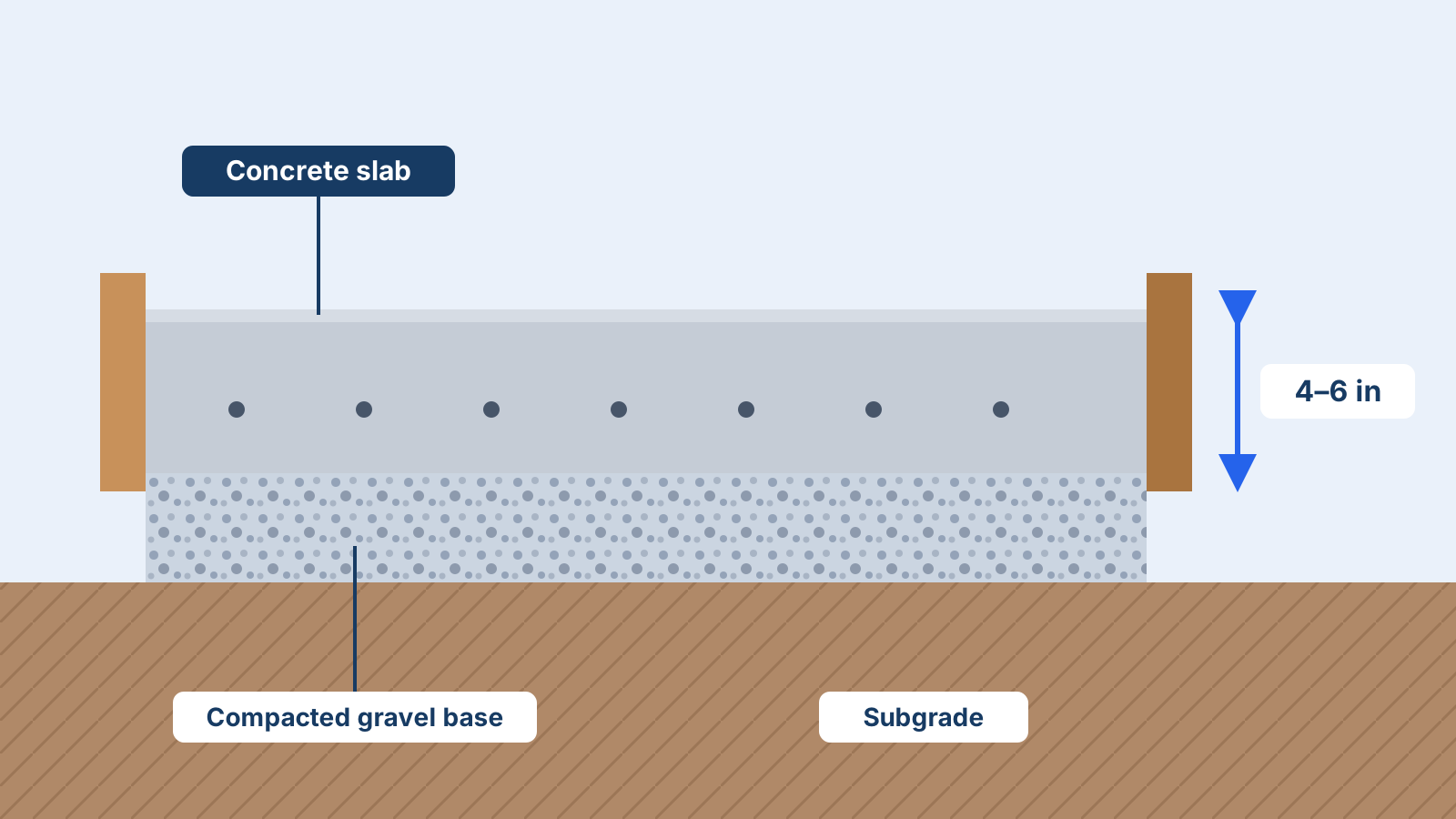
Real slabs are never perfectly flat underneath. The subgrade dips, forms bow outward slightly under the weight of wet concrete, and some material is lost in the wheelbarrow or pump hose. A waste allowance covers these losses.
| Situation | Suggested allowance |
|---|---|
| Well-compacted, laser-levelled base | 5% |
| Typical DIY patio or shed base | 8–10% |
| Uneven ground, long forms or hand placement | 10–15% |
If you are unsure, check the actual depth at several points across the base after compaction. A slab designed at 4 inches that averages 4.5 inches uses 12.5% more concrete.
Bags or ready-mix?
Pre-mixed bags are convenient for small jobs, but the numbers grow quickly. A typical 80 lb bag yields about 0.60 ft³, so a single cubic yard needs 45 bags weighing 3,600 lb in total.
When bags make sense
- Pads, steps and small repairs under about 1 yd³
- Sites a concrete truck cannot reach
- Projects you want to pour in stages
When ready-mix makes sense
- Anything over 1–1.5 yd³
- Slabs that must be poured in one continuous placement
- When you have helpers ready to place and finish quickly
Ready-mix suppliers often charge a short-load fee on small orders, so get a quote for both options. Our concrete bag calculator compares 40, 60 and 80 lb bags side by side.
Calculating irregular or L-shaped slabs
Break the slab into rectangles (and triangles if needed), calculate each piece separately and add them together. For a triangular section, the area is half of base × height.
Thickened edges, which are common on garage slabs and shed bases, should be calculated as separate footings using the concrete footing calculator and then added to the slab volume.
Try the Concrete Slab Calculator
Volume in cubic yards and metres plus the number of pre-mixed bags for patios, pads and floors.
Frequently asked questions
How many cubic yards is a 10 × 10 slab?
At 4 in thick, a 10 × 10 ft slab is 33.3 ft³, or 1.23 yd³ before waste. At 6 in thick it is 1.85 yd³.
How many bags of concrete for a 10 × 10 slab?
At 4 in thick you need about 56 × 80 lb bags before waste (33.3 ÷ 0.60), or about 62 with 10% extra.
Does rebar or mesh reduce the concrete needed?
Not meaningfully. Steel reinforcement takes up a tiny fraction of the volume, so ignore it in your calculation.
About the author
Written by the BuildCalcWorld Editorial Team. Our guides explain standard estimating methods with worked examples you can verify. Material properties vary by product and region, so always confirm specifications with your supplier. Published . Learn more about us.
Related articles
 Concrete
 Slab Thickness: A Practical Guide
How thick should a concrete slab be? Practical thickness ranges for patios, walkways, shed bases, driveways and garage floors, plus how thickness affects cost.
3 min read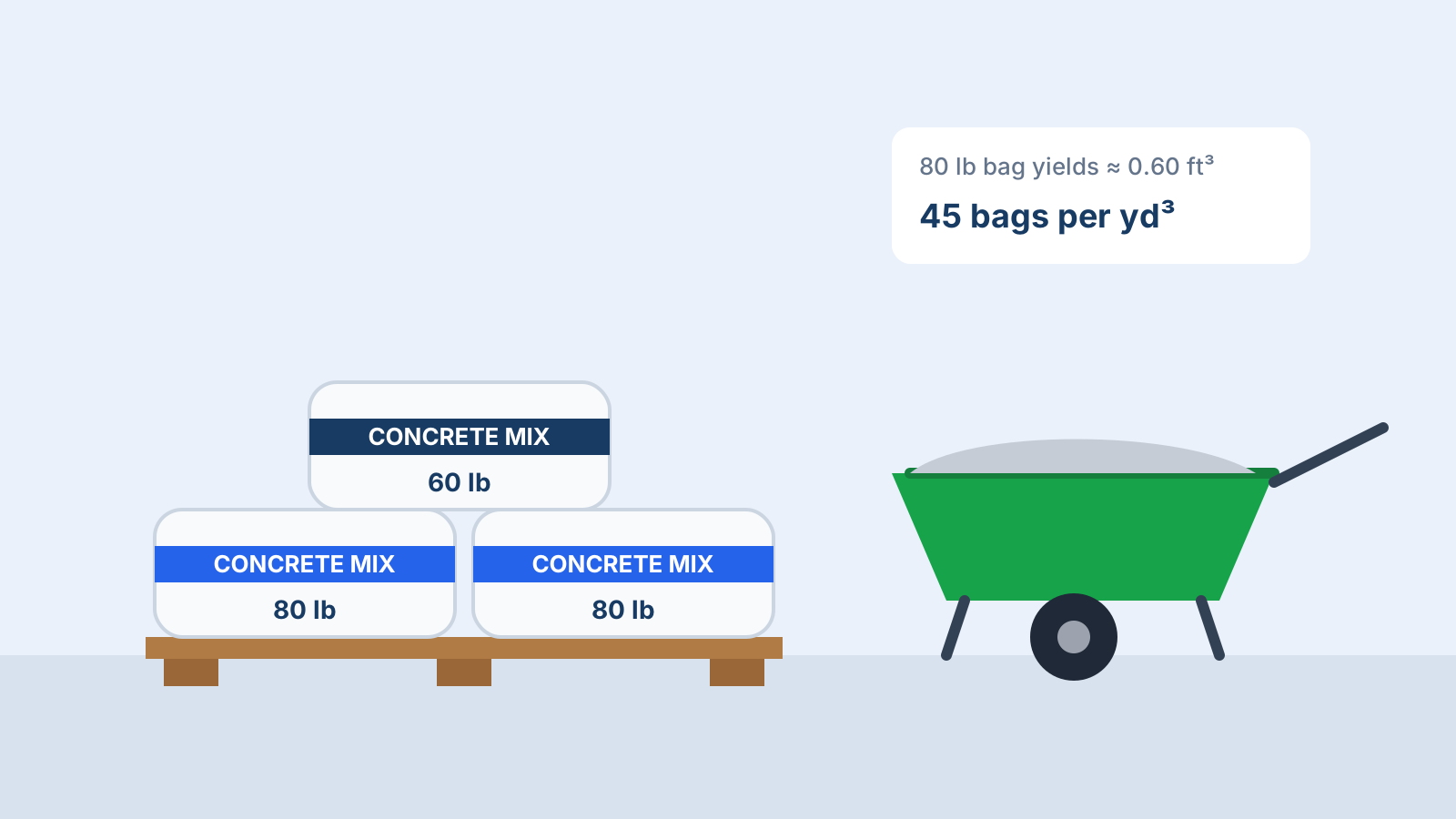 Concrete
 Bags Calculator: How Many Bags Do You Need?
Understand concrete bag yields, convert volume into bags, and compare 40, 60 and 80 lb bags (and 20–30 kg bags) with worked examples and a quick reference table.
2 min read