Concrete
How to Calculate Concrete for Fence Posts
Calculate how much concrete you need per fence post, including hole size, post displacement and gravel base, with examples for 4×4 and 6×6 posts.
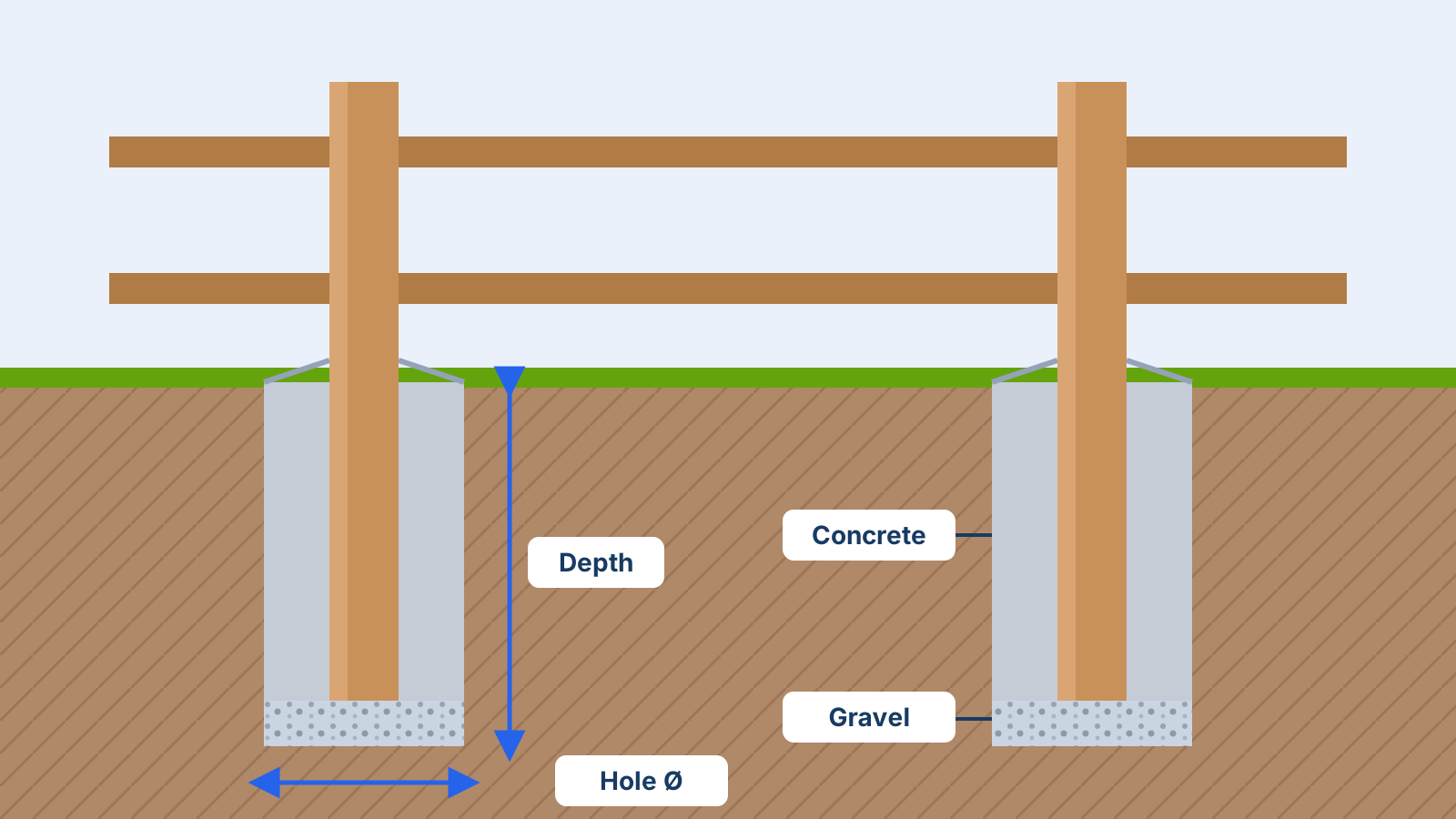
Most fence post guides tell you to buy "two bags per post" and leave it at that. That rule works for some fences, but a 6×6 gate post in a deep hole can easily need four or five bags, while short 4×4 posts in narrow holes need much less.
Here is how to work out the real number, using the size of your holes and posts.
Step 1: Decide on hole size
Two common guidelines are used by fence builders:
- Diameter: about three times the width of the post. A 4×4 (3.5 in actual) needs a 10–12 in hole; a 6×6 (5.5 in) needs 14–18 in.
- Depth: about one-third to one-half of the post's above-ground height, and below the frost line in cold climates.
Call your local utility locator service before digging. Buried cables and pipes are often shallower than people expect.
Step 2: Calculate the concrete per hole
A post hole is a cylinder. The post sits inside it and takes up some of that space, so subtract it:
Example
Formula
- Hole volume = π × radius² × depth
- Post volume = post width × post thickness × depth
- Concrete = hole volume − post volume
If you put gravel in the bottom of the hole for drainage, reduce the depth used in both formulas by the gravel depth.
Worked examples
4×4 post in a 10 in hole, 24 in deep
Example
Standard privacy fence post
- Hole: 3.1416 × 5² × 24 = 1,885 in³
- Post: 3.5 × 3.5 × 24 = 294 in³
- Concrete: 1,591 in³ ÷ 1,728 = 0.92 ft³
- 60 lb bags (0.45 ft³): 2.05 bags
- 80 lb bags (0.60 ft³): 1.53 bags
Result: About 2 × 60 lb bags or 1.5 × 80 lb bags per post.
6×6 gate post in a 16 in hole, 36 in deep with 4 in gravel
Example
Heavy gate post
- Concrete depth: 36 − 4 = 32 in
- Hole: 3.1416 × 8² × 32 = 6,434 in³
- Post: 5.5 × 5.5 × 32 = 968 in³
- Concrete: 5,466 in³ = 3.16 ft³
- 80 lb bags: 3.16 ÷ 0.60 = 5.3 bags
Result: Plan on 6 × 80 lb bags for this one post.
Mixing hole by hole vs in batches
If you mix a whole bag at a time and can't carry leftovers to the next hole, you need to round up per hole. Ten posts needing 2.05 bags each means 30 bags hole by hole, but only 21 if you share leftovers. The fence post concrete calculator shows both numbers.
Try the Fence Post Concrete Calculator
Bags of concrete for fence and deck post holes, minus the post volume.
Practical tips for setting posts
- Slope the top of the concrete away from the post so water runs off.
- Brace posts plumb in two directions before the concrete sets.
- Fast-setting concrete is convenient for posts but read the bag: its yield and water method can differ from standard mixes.
- Leave fence rails off until the concrete has cured enough to take load, as the manufacturer recommends.
Frequently asked questions
How many bags of concrete do I need for 10 fence posts?
For 4×4 posts in 10 in holes, 2 ft deep, about 21 × 60 lb bags if you share leftovers between holes, or 30 if you mix full bags per hole.
Can I set fence posts without concrete?
Yes. Many fences are set in compacted gravel or soil, which drains better around wooden posts. Concrete gives more rigidity, which is useful for gate posts and tall fences.
Should concrete go to the top of the hole?
Usually it is finished just above ground level and sloped away from the post. Some builders stop a few inches below grade and cover with soil for appearance.
About the author
Written by the BuildCalcWorld Editorial Team. Our guides explain standard estimating methods with worked examples you can verify. Material properties vary by product and region, so always confirm specifications with your supplier. Published . Learn more about us.
Related articles
 Concrete
 Bags Calculator: How Many Bags Do You Need?
Understand concrete bag yields, convert volume into bags, and compare 40, 60 and 80 lb bags (and 20–30 kg bags) with worked examples and a quick reference table.
2 min read Concrete
How Much Concrete Do I Need for a Concrete Slab?
Learn how to calculate concrete for a slab step by step, convert to cubic yards or cubic metres, add the right waste allowance and decide between bags and ready-mix.
3 min read